.jpg?width=3607&height=2326&name=High%20Res-13%20(2).jpg)

Financial Confidence in Senior Living
financial advocacy
.png?width=2250&height=2250&name=LinkedIn%20and%20graphics%20to%20use%20(7).png)

COMPASS SENIOR LIVING SOLUTIONS | THOUGHT LEADERSHIP
A personal reflection on this week’s Senior Housing News feature — and the strategy sitting quietly underneath every strategy in it.
By Sherrie Bebell, Compass Senior Living Solutions
I read this Senior Housing News feature — “From Chess to Checkers: Senior Living Operators Refine Sales Strategies to Sustain High Occupancy” — differently than most, because I read it as a roll call. The leaders and organizations in that piece are people I have known, respected, and worked alongside for as long as I’ve been in this industry. We have fought the same good fight, year after year: the lease-ups, the stabilizations, the rate letters, the staffing crunches, the long climb back after 2020. So when I say what follows comes from a place of deep respect, I mean it personally, not professionally.
And it’s precisely because I respect this work that I want to name the thread running underneath every strategy in that article — the one nobody says out loud, because it’s so foundational it’s easy to miss.
Every single high-occupancy strategy described in that piece assumes a financially confident family.
The strategies are real. Look at what each one requires.
The article captures the industry at a moment it has earned: NIC MAP average occupancy at 89.5% in the second quarter, median occupancy at 92%. The playbook is shifting from volume to precision — from chess to checkers, as Jaybird’s sales leadership memorably put it. Curated waitlists with real deposits. Zero lost revenue days. Rate integrity. Sales teams recast as revenue protectors. Lead budgets moving away from paid aggregators toward resident, family, and professional referrals. Every one of these is the right move. And every one of them rests on a family’s financial certainty:
This is not the industry the old resources were built for
Here is where I’ll say something with the candor of someone who has watched this industry evolve for decades: the financial resources senior living families have traditionally been handed were designed for a different era. Placement agencies compensated to move a family anywhere. Single-product solutions whose answer to every question is the one product they sell — “call us when the family needs the money.” Those models served a purpose in their time, and many of the people behind them have helped families in genuine ways. But they were built for a lower-occupancy industry competing on urgency, and they sit on the wrong side of the table for the game the industry is playing now.
At 92% median occupancy, the question is no longer how to generate more leads. It is how to make more of the families you already have — on the waitlist, in the funnel, and in the building — financially confident enough to say yes, stay long, and refer. That takes a fundamentally different resource: an advocate embedded in the sales process, working the family’s entire financial picture — income, savings, home equity, insurance, VA benefits, Medicaid pathways, bridge strategies — with no product to place and no placement fee to chase. One whose only deliverables are the family’s confidence and the operator’s occupancy.
We built for this moment, because we saw it coming
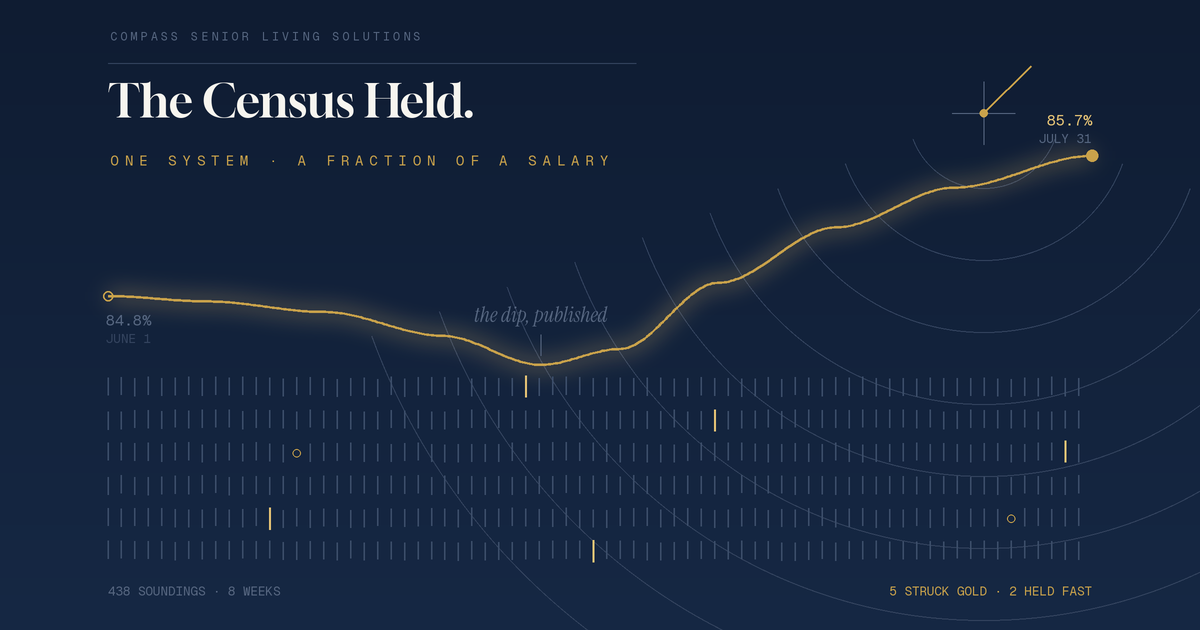
At Compass Senior Living Solutions, our Resource & Financial Advocacy program has been preparing for exactly the customer journey this article describes — because we have been living it alongside operators. Embedded across a 28-community portfolio, in the first five months of full integration the program delivered a net 53 additional move-ins versus the prior year (85% advocate-guided), an 8.3% reduction in financially lost leads, cost-cited move-outs falling across the portfolio, occupancy up 6% — and roughly $3.35 million in quantified impact, without discounting a single unit. Rate integrity intact. Both sides of the house, one advocate.
That last point matters most in the context of this week’s article: financial advocacy is not a lead-generation tactic from the lease-up era. It is a census-sustaining capability for the high-occupancy era — the mechanism that makes waitlists convert, rates hold, residents stay, and referrals flow.
To the leaders in that article
You have brought this industry to census levels many of us weren’t sure we would see again. The strategies you shared are the right ones, and you are executing them with the discipline this moment deserves. My conviction — built over the same years, in the same trenches — is simply this: the durable version of every one of those strategies runs through the family’s financial confidence. Financially confident and secure seniors and families are not one answer among many for sustaining high occupancy. They are the answer.
The game may have changed from chess to checkers. The winning move hasn’t changed at all: make it possible for the family to say yes — and keep saying yes, year after year.
You might also enjoy; "Senior Living Financial Advocate - the Missing Role"
Compass Senior Living Solutions helps operators and families find financial confidence in senior living. Our Resource & Financial Advocacy program embeds dedicated financial advocates inside the sales process — supporting the family’s entire financial journey, from waitlist to move-in through the full life of the residency. Book a meeting with our team or visit our website to learn more.
Sources: Senior Housing News, “‘From Chess to Checkers’: Senior Living Operators Refine Sales Strategies to Sustain High Occupancy” (July 7, 2026); NIC MAP Q2 2026 occupancy data as reported therein; Compass Resource & Financial Advocacy same-store case study, 28 communities, Jan–May 2026 vs. 2025. Views expressed about industry resources are the author’s own; the operators and leaders featured in the SHN article are cited as industry context and no endorsement is implied. Case-study results reflect one portfolio alongside a well-run operator’s broader strategy; results vary by community, market, and execution.