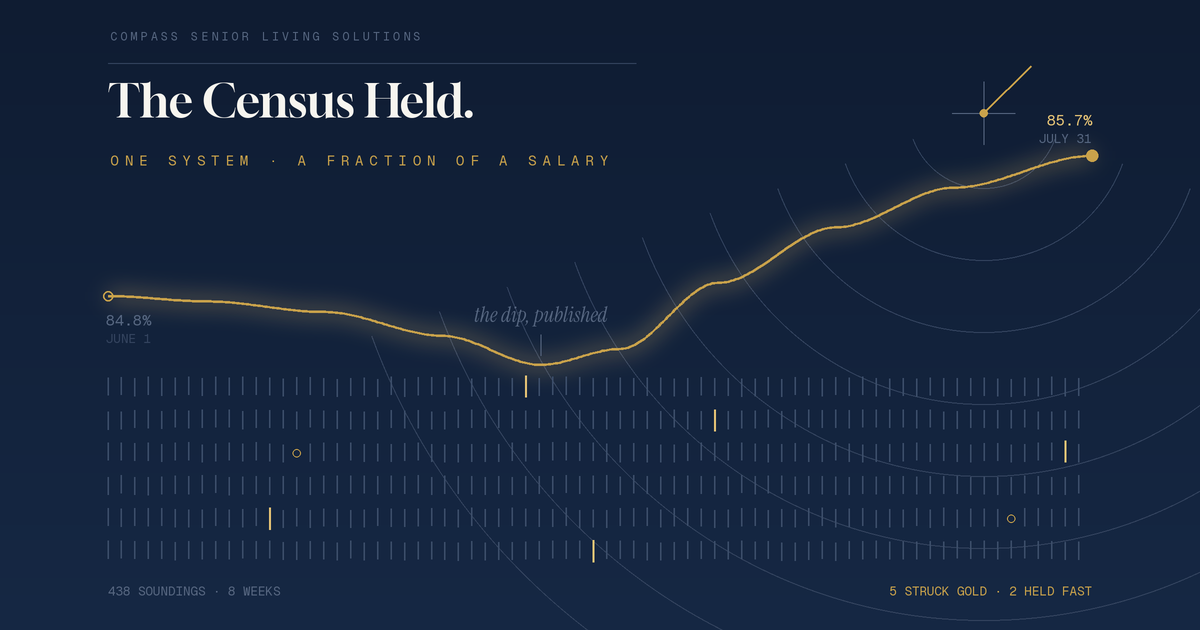
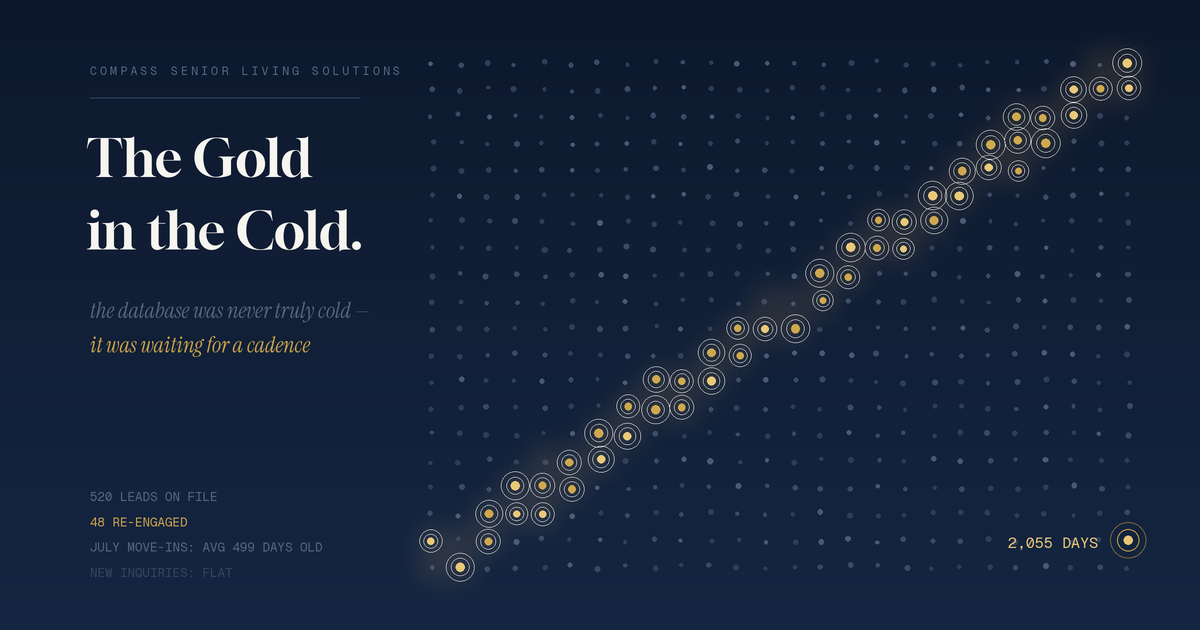
Entering June 2026, a 207-unit senior living community stood at 84.8% occupancy heading into summer — the season when move-outs pressure every census. Its CRM held more than 520 active leads, over 420 of them cold: inquiries the community had already paid to generate, going stale.
The onsite sales team was doing exactly what onsite teams do — tours, families, move-ins, events. But two jobs structurally fall off a stretched sales desk, and they are the two that decide whether a database converts: persistent multi-touch follow-up and answering "how do we pay for this?" with a real plan.
The wrapped system
Compass wrapped two fractional services around the existing onsite team — no new full-time hire, no replacement of anyone's role:
A Remote Sales Specialist (RSS), 3–7.5 hours per week, owns persistence: speed-to-lead, text-first multi-channel cadence, database re-engagement and hygiene, and tour scheduling. The RSS doesn't close — she manufactures at-bats for the people who do.
The CFA financial advocacy program owns confidence: financial discoveries with families and identification of funding resources — VA benefits, long-term care policies, bridge solutions, home-sale strategy. Many "cold" leads aren't disinterested; they're financially stalled. The CFA re-qualifies them.
And the onsite team keeps what it should own: relationships, tours, and closes — now fed warmer, financially confident prospects.
Eight weeks of activity
438
PERSONAL TOUCHES | 50
TOURS COMPLETED | 5
MOVE-INS (DIRECTIONAL) | 2
MOVE-OUTS PREVENTED |
In 44.5 fractional RSS hours (about 6 per week), the system produced 438 personal touches — 137 calls, 165 texts, 136 emails. The phone connection rate climbed from 25% to a peak of 51% as the text-first cadence warmed the database. The active database still grew from 521 to 547 even as 130 stale leads were closed out.
And the census tells an honest story: occupied units dipped to 174 mid-period as summer move-outs hit, then recovered to 177.5 — occupancy grew from 84.8% to 85.7% through move-out season. We publish the dip on purpose.
The ROI stress test
Total program investment for the two-month period: $4,437.50 — at the community's $4,300 average monthly rate, roughly one month's rent of a single apartment. Here is the return at three levels of attribution, including the one built for skeptics:
| Scenario | Assumption | First-year revenue | Return |
|---|
| Skeptic's floor | Credit only ONE of the five move-ins | $51,600 | 11.6 : 1 |
| Directional | Credit the five move-ins tracked through the program | $258,000 | 58 : 1 |
| Census-only anchor | Ignore attribution; value only the +2 net occupied units (annualized) | $103,200/yr | 3.3 : 1 |
The breakeven line: program cost equals just 8.6% of a single move-in's first-year rent. An operator doesn't have to accept our attribution to accept the ROI — the program pays for itself unless it influenced less than one-eleventh of one move-in over two months.
How we measure — and why some numbers are "directional"
The operator's onsite team controls the CRM, and lead ownership is routinely reassigned at tour and move-in. Rather than claim a precision the data doesn't support, we report individual move-in attribution as directional — and rest the ROI case on numbers no one can reassign: hours billed, program fees, and net occupied units. On every engagement: net census published with the dips left in, every percentage reproducible from stated raw counts, gross move-ins and net census shown together, and attribution labeled honestly.
The takeaway
This community didn't need another full-time hire. It needed a system: fractional persistence, financial advocacy, and an onsite team freed to sell. Eight weeks, one work-week of fractional sales time, about a month's rent in total cost — 438 personal touches, 50 tours, a cleaner database, five move-ins, two saved residents, and a census that grew through move-out season.
.jpg?width=3607&height=2326&name=High%20Res-13%20(2).jpg)